
On the initial boundary value problem in numerical relativity
23 Jan 2025Conner Dailey
Full text
Abstract
The principal goal of this thesis is to properly understand, characterize, and numerically implement initial boundary value problems in numerical relativity. Throughout the history of solving Einstein’s field equations on computers, boundaries have been mostly dealt with in an approximate way. For example, boundaries might be placed far away from strongly gravitating sources, where approximations like linearized gravity are valid. It has become necessary however to place boundaries in the strong gravity regime of a dynamical spacetime to model complicated and interesting physics, which necessitates a complete understanding of the initial boundary value problem of Einstein’s field equations. One motivation for this comes from a need to simulate black hole echoes. In classical general relativity, black holes are perfectly absorbing objects, where the mass of radially incoming wavepackets of matter or gravitational waves is absorbed by the black hole. Thus conclusive evidence of modifications to general relativity, such as quantum gravity, could include partial reflections of radially incoming wavepackets, called black hole echoes. To properly understand the modifications this would bring to detectable gravitational wave signals, we require simulations where reflecting boundary conditions are imposed close to the horizon of a black hole. Another motivation comes from recent advances in Cauchy characteristic matching, which combines state of the art numerical techniques to obtain physically accurate gravitational waveforms from simulations. This can allow numerical relativists to dramatically save on the computational cost of black hole merger simulations, but only if boundaries can be placed in the strong gravity regime. This thesis presents advances in simulating initial boundary value problems in numerical relativity. Starting with spherical symmetry, a framework for reflecting a scalar field in a fully dynamical spacetime is developed and implemented numerically using the Einstein-Christoffel formulation. The evolution of a wave packet and its numerical convergence, including when the location of a reflecting boundary is very close to the horizon of a black hole, is studied. Next, this approach is generalized to spacetimes with no symmetries and implemented numerically using the generalized harmonic formulation. The evolution equations are cast into a summation by parts scheme, which seats the numerical method closer to a class of provably numerically stable systems. State of the art numerical methods are demonstrated, including an embedded boundary numerical method that allows for arbitrarily shaped domains on a rectangular grid and even boundaries that evolve and move across the grid. As a demonstration of these frameworks, the evolution of gravitational wave scattering off of a boundary either inside or just outside the horizon of a black hole, is studied. Finally, a boundary condition framework designed to control quasi-local energy flux is proposed motivated by examples from electromagnetism.
Overview
My Ph.D. was done at the University of Waterloo with residency at the Perimeter Institute for Theoretical Physics, advised by Niayesh Afshordi and Erik Schnetter. The thesis brings together and extends my work on boundaries in numerical relativity:
- Chapter 2, Numerical relativity in spherical symmetry: reflecting boundary conditions for a scalar field in a fully dynamical spacetime, using the Einstein-Christoffel formulation. This builds on my paper Reflecting boundary conditions in numerical relativity as a model for black hole echoes.
- Chapter 3, Spacetimes with no symmetries: the generalized harmonic formulation cast into a summation by parts scheme, an embedded boundary method for arbitrarily shaped domains, and gravitational wave scattering off a boundary near a black hole horizon. This builds on my paper Formulating the complete initial boundary value problem in numerical relativity to model black hole echoes.
- Chapter 4, Boundary conditions based on quasi-local conservation laws: a framework for boundary conditions that control the quasi-local energy flux through a boundary, motivated by analogous examples in electromagnetism.
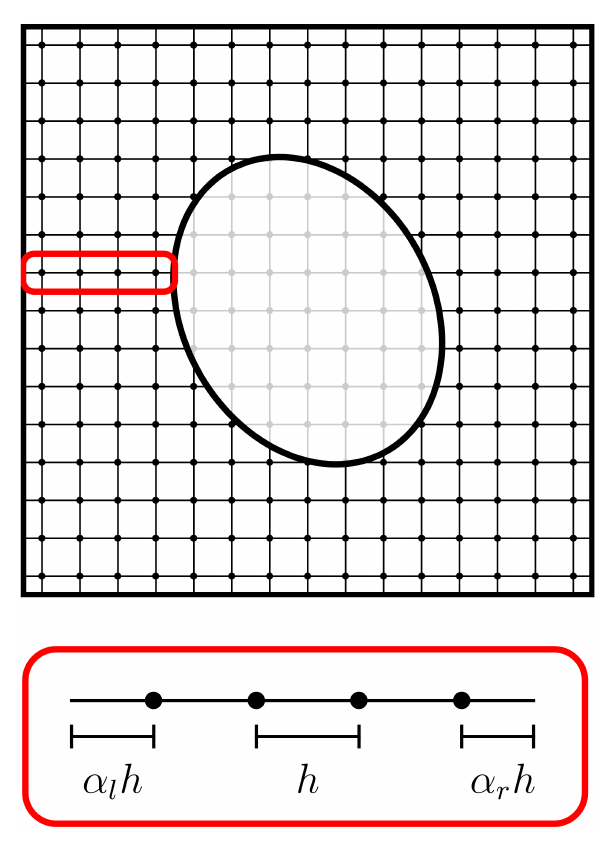
The embedded boundary method on a 2D slice. The grid points inside the ellipse exist in memory but are not evolved. Finite differencing stencils along each grid line depend on the grid spacing \(h\) and on the distances \(\alpha_l h\) and \(\alpha_r h\) from the boundary to the ends of the line (zoomed in red).
The simulation code is available at GR3D.jl on GitHub.
Conclusion
This thesis demonstrates and formulates the initial boundary value problem in numerical relativity, so that Einstein’s field equations can be evolved with boundaries placed in the strong gravity region of a dynamical spacetime. The motivations are to simulate black hole echoes by imposing reflecting boundary conditions near a horizon, to make binary black hole merger simulations cheaper by coupling with Cauchy characteristic matching and shrinking the Cauchy domain, and to simulate arbitrary compact objects given only the evolution of a surface around them and the boundary conditions on it.
Part of this success comes from analytical tools that guide the form of the evolution equations, such as symmetric hyperbolicity, which allows for an energy estimate. The other part comes from modern numerical methods: summation by parts operators and simultaneous approximation terms keep the energy estimate approximately conserved on a discrete grid, and embedded boundary methods allow arbitrarily shaped domains on a rectangular grid. Finally, boundary conditions on the radiative degrees of freedom of the metric can be set by controlling the quasi-local energy flux through the boundary. Like electromagnetic waves, gravitational waves need two conditions: one for conservation of energy and one to specify polarization.
These methods open the door to non-spherical and non-convex inner boundaries, dynamical inner boundaries, non-cubical outer boundaries, and higher accuracy operators (see my follow-up work on upwind embedded boundary SBP operators). Evolving a dynamical boundary tied to dynamical black holes would allow merger simulations with reflecting boundaries near the horizons, which would be the first nonlinear simulation of black hole echoes.